
The Lake Erie Inquiry
Built automatically by an AI system at 4:03 a.m. It will sometimes be wrong — sources are named beneath every item. Submit a correction here.Elaborada automáticamente por un sistema de inteligencia artificial a las 4:03 a.m. A veces se equivocará — las fuentes se nombran debajo de cada nota. Envíe una corrección aquí.
The state put $3 million into housing in this region last weekEl estado destinó 3 millones de dólares a vivienda en esta región la semana pasada
Toledo gets $2 million to prepare the Spitzer Building, empty at the corner of Huron and Madison, for about 180 apartments. Bowling Green gets $1 million to cut 117 house lots into a field near Brim and Bishop roads.Toledo recibe 2 millones de dólares para preparar el Edificio Spitzer, vacío en la esquina de Huron y Madison, para unos 180 apartamentos. Bowling Green recibe 1 millón para trazar 117 lotes de vivienda en un campo cerca de las carreteras Brim y Bishop.
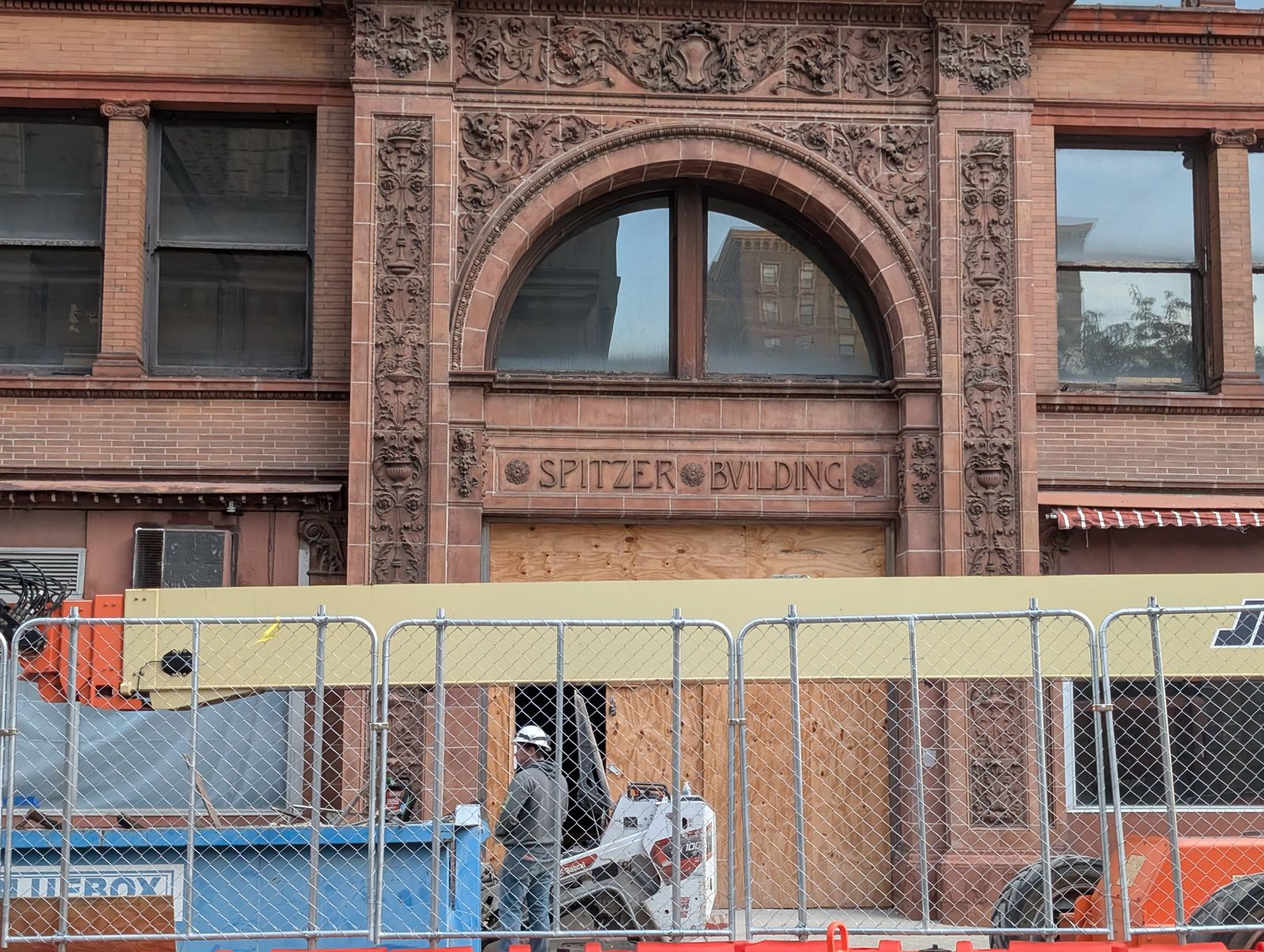
The City of Toledo was awarded $2 million on Friday, Sept. 11 from the State of Ohio’s Residential Economic Development District program, known as REDD, for new water and sewer lines at the Spitzer Building at Huron Street and Madison Avenue downtown. That is narrower than the “site readiness” the city’s release calls it, and the narrower description is the state’s own: Brian Bohnert of the Ohio Department of Development gave it to The Blade. The city announced the award in a release on Monday. The Lucas County Land Bank owns the building and runs the project with the city.La Ciudad de Toledo recibió 2 millones de dólares el viernes 11 de septiembre del programa estatal de Ohio Residential Economic Development District, conocido como REDD, para nuevas líneas de agua y alcantarillado en el Edificio Spitzer, en las calles Huron y Madison, en el centro. Eso es más estrecho que la «preparación del terreno» que dice el comunicado de la ciudad, y la descripción más estrecha es del propio estado: la dio a The Blade Brian Bohnert, del Departamento de Desarrollo de Ohio. La ciudad anunció la adjudicación en un comunicado el lunes. El Lucas County Land Bank es dueño del edificio y dirige el proyecto junto con la ciudad.
On the same list, the City of Bowling Green was awarded $1 million for the planned Green Acres Subdivision near the intersection of Brim and Bishop roads: 117 workforce housing lots, which the city ties to housing demand created by the Amazon investment and others in Wood County.En la misma lista, la Ciudad de Bowling Green recibió 1 millón de dólares para la proyectada Green Acres Subdivision, cerca del cruce de las carreteras Brim y Bishop: 117 lotes de vivienda para trabajadores, que la ciudad vincula a la demanda de vivienda generada por la inversión de Amazon y otras en el condado de Wood.
What REDD is, in plain terms: a state grant program that pays for the work that happens before anyone builds a home (clearing, utilities, streets, the readying of a site) when that site sits near a large economic-development project. It does not build the housing and it does not pay a developer’s construction cost. Governor Mike DeWine and Development Director Lydia Mihalik announced this round of it, $14 million across 10 counties. The department says it received 32 eligible applications asking for nearly $69 million; this is the second round, after more than $9 million went out in March.Qué es el REDD, en términos sencillos: un programa estatal de subvenciones que paga el trabajo que ocurre antes de que alguien construya una vivienda (despeje, servicios públicos, calles, la preparación del terreno) cuando ese terreno está cerca de un gran proyecto de desarrollo económico. No construye la vivienda ni paga el costo de construcción de un promotor. El gobernador Mike DeWine y la directora de Desarrollo Lydia Mihalik anunciaron esta ronda: 14 millones de dólares en 10 condados. El departamento dice que recibió 32 solicitudes elegibles por casi 69 millones; esta es la segunda ronda, después de que en marzo se repartieran más de 9 millones.
The program is built on a radius, and the radius is what makes a REDD award readable. Under the section of the Revised Code it runs on, a residential economic development district is every parcel within twenty miles of a “major economic development project” — which the statute defines as one expected to create at least 700 permanent jobs or draw at least $700 million in private investment. Every award therefore answers a question about proximity: which big employer is this housing meant to be near? Bowling Green’s answer is in the governor’s own announcement — Amazon, and other investment in Wood County. Toledo’s came from State Rep. Michele Grim, a Toledo Democrat, who put the award “following critical investments from General Motors and Stellantis in the Toledo community.” Neither the city’s release nor the state’s announcement names a qualifying project for the Toledo award in so many words, and this paper has not seen the application.El programa se construye sobre un radio, y el radio es lo que hace legible una adjudicación REDD. Según el artículo del código estatal que lo rige, un distrito residencial de desarrollo económico es toda parcela situada a menos de veinte millas de un «gran proyecto de desarrollo económico», que la ley define como aquel del que se espera que cree al menos 700 empleos permanentes o atraiga al menos 700 millones de dólares de inversión privada. Cada adjudicación responde, pues, a una pregunta de cercanía: ¿junto a qué gran empleador se quiere esta vivienda? La respuesta de Bowling Green está en el anuncio del gobernador: Amazon y otras inversiones en el condado de Wood. La de Toledo la dio la representante estatal Michele Grim, demócrata de Toledo, que situó la adjudicación «tras las inversiones decisivas de General Motors y Stellantis en la comunidad de Toledo». Ni el comunicado de la ciudad ni el anuncio del estado nombran con todas las letras un proyecto habilitante para la adjudicación de Toledo, y este periódico no ha visto la solicitud.
The round itself is worth a line. Grants run from $250,000 to $2.5 million, so Toledo’s $2 million is near the top of what the program gives. Four awards this round were $2 million — Cleveland, Cincinnati, Piketon and Toledo — and six were $1 million — Bowling Green, Columbus, Heath, Niles, Oberlin and Xenia. The program has $25 million to give in all.La ronda misma merece una línea. Las subvenciones van de 250,000 a 2.5 millones de dólares, de modo que los 2 millones de Toledo están cerca del techo del programa. Cuatro adjudicaciones de esta ronda fueron de 2 millones —Cleveland, Cincinnati, Piketon y Toledo— y seis de 1 millón —Bowling Green, Columbus, Heath, Niles, Oberlin y Xenia—. El programa dispone de 25 millones en total.
The Toledo project the money attaches to is large. The city describes the Spitzer as phase one of a Four Corners District rehabilitation: about 250,000 square feet, about 180 residential units, with 30 percent reserved at 80 percent of Area Median Income. The city puts the whole project at $92 million, with about $18.3 million in public money already committed: state historic tax credits, brownfield and demolition grants, Land Bank funds and city ARPA money. Construction, the city says, “is expected to begin in late 2026 or early 2027,” and it estimates about 800 construction jobs. Phases two and three would be the Nicholas and Nasby buildings.El proyecto de Toledo al que se destina el dinero es grande. La ciudad describe el Spitzer como la primera fase de una rehabilitación del Four Corners District: unos 250,000 pies cuadrados, unas 180 unidades residenciales, con el 30 por ciento reservado al 80 por ciento del Ingreso Medio del Área. La ciudad cifra el proyecto completo en 92 millones de dólares, con unos 18.3 millones en dinero público ya comprometido: créditos fiscales históricos estatales, subvenciones de terrenos contaminados y demolición, fondos del Land Bank y dinero ARPA de la ciudad. La construcción, dice la ciudad, «se espera que comience a finales de 2026 o principios de 2027», y estima unos 800 empleos de construcción. Las fases dos y tres serían los edificios Nicholas y Nasby.
Mayor Wade Kapszukiewicz, in the city’s release, called it “nearly 200 new homes” and thanked the governor and the Ohio Department of Development. David Mann, president and chief executive of the Land Bank, said the award would “unlock nearly $92 million in private investment and set the stage for the Nicholas and Nasby buildings.” The unit counts move around, and they do reconcile. The city’s release says about 180; the mayor said “nearly 200”; Rep. Grim said 200. The Ohio Department of Development’s own figure is 180 to 200 for the Spitzer. The 400 that appears on the Land Bank’s project page is the Spitzer and the Nicholas together, not the Spitzer alone.El alcalde Wade Kapszukiewicz, en el comunicado de la ciudad, habló de «casi 200 viviendas nuevas» y agradeció al gobernador y al Departamento de Desarrollo de Ohio. David Mann, presidente y director ejecutivo del Land Bank, dijo que la adjudicación «desbloqueará casi 92 millones de dólares de inversión privada y preparará el terreno para los edificios Nicholas y Nasby». Las cifras de unidades varían, y sí se concilian. El comunicado de la ciudad dice unas 180; el alcalde habló de «casi 200»; la representante Grim dijo 200. La cifra del propio Departamento de Desarrollo de Ohio es de 180 a 200 para el Spitzer. Las 400 que figuran en la página del Land Bank son el Spitzer y el Nicholas juntos, no el Spitzer solo.
The developer has a name and a clock. The Land Bank’s own page for the Four Corners Project names The RKP Group, puts the two-building redevelopment at $190 million, and says a pre-development agreement authorized in September 2025 gave RKP the exclusive right to redevelop the buildings for twelve months if conditions were met. Twelve months from September 2025 is about now. Whether that was met, extended, or allowed to lapse is not on the page, and this paper has not asked. The agreement is the Land Bank’s to make and not the city’s, which is why it is not in council’s record.
What has not happened yet is worth saying plainly, because none of it is an accusation. No construction has begun. The private financing behind the $92 million has not been reported closed. There is no ordinance before council accepting the $2 million — this paper searched the city’s legislative record, every matter introduced since Aug. 1 and the whole record by keyword, and there is none. That is a step ahead rather than a step skipped: the award is four days old. What the record does hold for this building is older and smaller. In 2020 council spent $100,000 on critical assessments of the Spitzer and the Nicholas, passed as an emergency; in 2022 it accepted unspent Land Bank grant proceeds for the same assessments. The city’s federal recovery money reaches the Land Bank through brownfield agreements that name sites in general and do not itemize the Spitzer’s share. And in January, Councilman Martinez asked the administration how many Toledoans were working the remediation of the Spitzer — a referral the record marks answered. Remediation was under way eight months ago. Construction is the thing that has not started, and the two are not the same. The paper last named this building on Aug. 23, when leasing opened at the Spitzer — a detail that still sits oddly beside a building being readied for rehabilitation, and one the desk is carrying forward.El promotor tiene nombre y reloj. La propia página del Land Bank sobre el Four Corners Project nombra a The RKP Group, cifra la rehabilitación de los dos edificios en 190 millones de dólares y dice que un acuerdo de predesarrollo autorizado en septiembre de 2025 dio a RKP el derecho exclusivo a rehabilitarlos durante doce meses si se cumplían ciertas condiciones. Doce meses desde septiembre de 2025 es más o menos ahora. Si se cumplieron, se prorrogó o se dejó vencer no consta en la página, y este periódico no lo ha preguntado. El acuerdo le corresponde al Land Bank y no a la ciudad, y por eso no está en el registro del concejo.
Lo que todavía no ha ocurrido merece decirse con claridad, porque nada de ello es una acusación. No ha comenzado ninguna construcción. No se ha informado del cierre del financiamiento privado detrás de los 92 millones. No hay ninguna ordenanza ante el concejo que acepte los 2 millones: este periódico revisó el registro legislativo de la ciudad —todos los asuntos presentados desde el 1 de agosto y el registro completo por palabra clave— y no la hay. Eso es un paso pendiente, no un paso omitido: la adjudicación tiene cuatro días. Lo que sí guarda el registro sobre este edificio es más antiguo y más pequeño. En 2020 el concejo gastó 100,000 dólares en evaluaciones críticas del Spitzer y el Nicholas, aprobadas por vía de urgencia; en 2022 aceptó fondos no gastados de una subvención del Land Bank para esas mismas evaluaciones. El dinero federal de recuperación de la ciudad llega al Land Bank por acuerdos sobre terrenos contaminados que nombran sitios en general y no desglosan la parte del Spitzer. Y en enero el concejal Martinez preguntó a la administración cuántos toledanos trabajaban en la remediación del Spitzer, una consulta que el registro marca como respondida. La remediación estaba en marcha hace ocho meses. Lo que no ha empezado es la construcción, y no son lo mismo. El periódico nombró este edificio por última vez el 23 de agosto, cuando abrió el alquiler en el Spitzer, un detalle que sigue encajando mal junto a un edificio que se prepara para rehabilitación, y que la redacción sigue investigando.
The two awards are worth reading together. Toledo’s money goes into a century-old office block downtown that has to be made habitable before anyone lives in it. Bowling Green’s goes into a field that has to be made into streets and lots before anyone builds on it. The state counted both as the same kind of problem (people who have work here and nowhere near it to live) and paid for the same part of the answer in both places: the part before the housing.Vale la pena leer juntas las dos adjudicaciones. El dinero de Toledo va a un edificio de oficinas centenario en el centro que hay que hacer habitable antes de que alguien viva en él. El de Bowling Green va a un campo que hay que convertir en calles y lotes antes de que alguien construya en él. El estado contó ambos como el mismo tipo de problema (gente que trabaja aquí y no tiene dónde vivir cerca) y pagó la misma parte de la respuesta en los dos sitios: la parte anterior a la vivienda.
Sources: City of Toledo; The Blade; BG Independent News; Ohio Department of Development; Lucas County Land Bank; the City of Toledo’s legislative record; the Ohio Revised Code; Dayton Daily News; The Highland County Press.Fuentes: Ciudad de Toledo; The Blade; BG Independent News; Departamento de Desarrollo de Ohio; Lucas County Land Bank; el registro legislativo de la Ciudad de Toledo; el código estatal de Ohio; Dayton Daily News; The Highland County Press.
CONTINUE TO THE REST OF THE PAPER →Esta nota abrió la No. 48. La edición es la unidad de este periódico: la viñeta, el resumen, las secciones, las correcciones y las fuentes viven allí, no aquí.
SEGUIR AL RESTO DEL PERIÓDICO →