The Lake Erie Inquiry
Election ’26Elecciones ’26
4days to Nov. 3días al 3 de nov.Ballot questions, Lucas CountyPreguntas de la boleta, condado de Lucas
Maumee City Schools Issue 5Escuelas de Maumee, asunto 5
Maumee Schools asks for a 1.25% income tax with no end dateLas escuelas de Maumee piden un impuesto sobre ingresos de 1.25% sin fecha de fin
Maumee City Schools asks for a new 1.25% tax on residents’ earned income, with no end date, starting Jan. 1, 2027, for current expenses, according to the ballot. The district has no income tax now, and nothing on property tax bills changes with this vote.Las Escuelas de la Ciudad de Maumee piden un impuesto nuevo de 1.25% sobre los ingresos del trabajo de los residentes, sin fecha de fin, a partir del 1 de enero de 2027, para gastos corrientes, según la boleta. El distrito no tiene impuesto sobre ingresos ahora, y nada cambia en las facturas del impuesto a la propiedad con este voto.
Who pays it?¿Quién lo paga?
Residents of the school district, on wages and self-employment earnings. State law leaves out pensions, Social Security and investment income, and people who work in the school district but live elsewhere do not pay it.Los residentes del distrito escolar, sobre sus salarios y ganancias del trabajo por cuenta propia. La ley estatal deja fuera las pensiones, el Seguro Social y los ingresos de inversiones, y quienes trabajan en el distrito escolar pero viven en otro lugar no lo pagan.
What would a working household pay?¿Cuánto pagaría un hogar que trabaja?
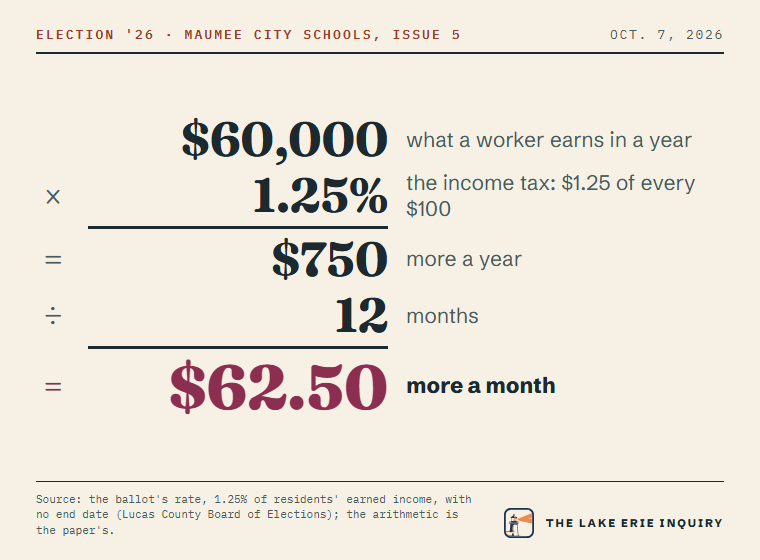
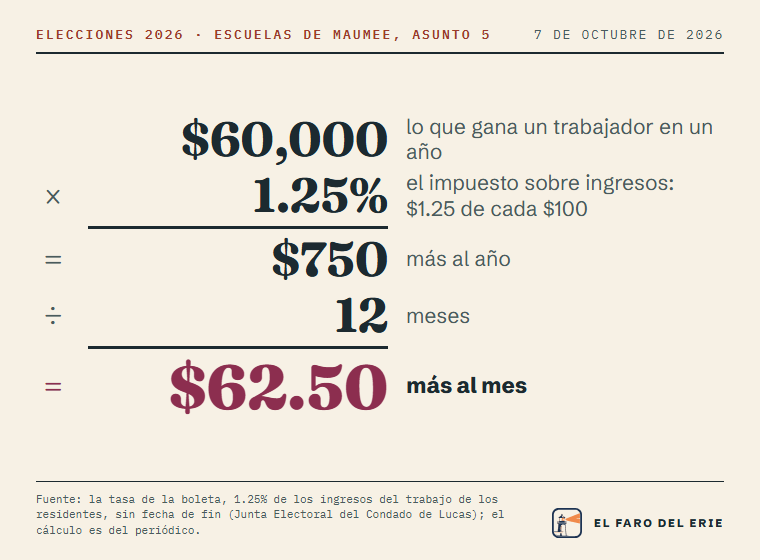
A resident who earns $60,000 would pay $750 a year, about $62.50 a month. Two earners making $60,000 each would pay $1,500.Un residente que gana $60,000 pagaría $750 al año, unos $62.50 al mes. Dos personas que ganan $60,000 cada una pagarían $1,500.
And a retiree?¿Y un jubilado?
A retiree living on a pension and Social Security pays nothing. Wages from a part-time job would be taxed.Un jubilado que vive de una pensión y del Seguro Social no paga nada. El salario de un trabajo de medio tiempo sí pagaría.
How much would it raise?¿Cuánto recaudaría?
About $6.2 million a year once fully collected: $6,183,386, the district said in written answers sent by Superintendent Steve Lee. The ballot gives no figure. The district’s five-year forecast shows more than that in 2029 and 2030, about $6.6 million and $7 million. The district says that is timing, not growth: part of an income tax is paid with each year’s tax return, a year late, so in the early years those catch-up payments land on top of the regular paycheck withholding. After that, collections settle at about $6.2 million a year.Unos $6.2 millones al año una vez cobrado por completo: $6,183,386, dijo el distrito en respuestas por escrito enviadas por el superintendente Steve Lee. La boleta no da cifra. El pronóstico a cinco años del distrito muestra más que eso en 2029 y 2030, unos $6.6 millones y $7 millones. El distrito dice que es cuestión de tiempos, no de crecimiento: parte de un impuesto sobre ingresos se paga con la declaración de impuestos de cada año, un año después, así que en los primeros años esos pagos atrasados se suman a las retenciones regulares de los cheques de pago. Después, la recaudación se estabiliza en unos $6.2 millones al año.
Why does the district say it needs the money?¿Por qué dice el distrito que necesita el dinero?
It spent $38.8 million from its general fund in the 2026 school year and took in $37.2 million, the forecast shows. Without new money, its balance falls below zero in the 2029 school year and reaches $18.1 million in the red in 2030. With the tax, the forecast ends 2030 with about $155,000 left. It assumes health insurance rises 19% next year, the most the district’s carrier has guaranteed, and an estimated 10% a year after that.Gastó $38.8 millones de su fondo general en el año escolar 2026 y recibió $37.2 millones, según el pronóstico. Sin dinero nuevo, su saldo cae por debajo de cero en el año escolar 2029 y llega a $18.1 millones en números rojos en 2030. Con el impuesto, el pronóstico termina 2030 con unos $155,000. Supone que el seguro médico sube 19% el próximo año, lo máximo que ha garantizado la aseguradora del distrito, y un estimado de 10% al año después.
What if it fails?¿Y si no pasa?
The board has not approved a list of cuts, the district said, but its preliminary plans include larger classes, fewer middle and high school courses, less student support, changes to who gets bus service and fewer custodians.La junta no ha aprobado una lista de recortes, dijo el distrito, pero sus planes preliminares incluyen clases más grandes, menos cursos en la secundaria y la preparatoria, menos apoyo a los estudiantes, cambios en quién recibe transporte escolar y menos personal de limpieza.
Does it end?¿Tiene fin?
No. The board chose a tax with no end date because the district’s operating costs are ongoing, the district said.No. La junta eligió un impuesto sin fecha de fin porque los gastos de operación del distrito son permanentes, dijo el distrito.
Sources: Lucas County Board of Elections, official sample ballot; Ohio Revised Code; Maumee City Schools, five-year forecast (Ohio Department of Education and Workforce) and written answers; Ohio Department of Education and Workforce, report card dataFuentes: Junta Electoral del Condado de Lucas, boleta de muestra oficial; Código Revisado de Ohio; Escuelas de la Ciudad de Maumee, pronóstico a cinco años (Departamento de Educación y Fuerza Laboral de Ohio) y respuestas por escrito; Departamento de Educación y Fuerza Laboral de Ohio, datos del boletín de calificaciones
Maumee City Schools imposes a new 1.25% tax on residents' earned income with no end date, starting Jan. 1, 2027, for current expenses.Las Escuelas de la Ciudad de Maumee cobran un impuesto nuevo de 1.25% sobre los ingresos del trabajo de los residentes, sin fecha de fin, desde el 1 de enero de 2027, para gastos corrientes.
No income tax is imposed. The district's existing property-tax levies are not on this ballot and are not changed by this vote.No se cobra el impuesto sobre ingresos. Los impuestos a la propiedad que el distrito ya cobra no están en esta boleta y este voto no los cambia.
How it reads on your ballotCómo se lee en su boleta (en inglés)
Proposed Income Tax
Maumee City School District
A majority affirmative vote is necessary for passage.
Shall an annual income tax of 1.25% on the earned income of individuals residing in the school district be imposed by the Maumee City School District, for a continuing period of time, beginning January 1, 2027, for the purpose of current expenses?
Source: Lucas County Board of Elections, official sample ballotFuente: Junta Electoral del Condado de Lucas, boleta de muestra oficial
◂ Election ’26: every race and question◂ Elecciones ’26: cada contienda y pregunta
Edited by Zach BrookeEditado por Zach Brooke