
The Lake Erie Inquiry
Election ’26Elecciones ’26
4days to Nov. 3días al 3 de nov.Ballot questions, Lucas CountyPreguntas de la boleta, condado de Lucas
Springfield Local Schools Issue 6Escuelas de Springfield, asunto 6
Springfield Schools asks for a five-year, half-percent income taxLas escuelas de Springfield piden un impuesto de medio por ciento sobre ingresos por cinco años
Springfield Local Schools asks for a new 0.5% tax on residents’ earned income for five years, starting Jan. 1, 2027, for current expenses, according to the ballot. Nothing on property tax bills changes with this vote.Las Escuelas Locales de Springfield piden un impuesto nuevo de 0.5% sobre los ingresos del trabajo de los residentes por cinco años, a partir del 1 de enero de 2027, para gastos corrientes, según la boleta. Nada cambia en las facturas del impuesto a la propiedad con este voto.
Who pays it?¿Quién lo paga?
Residents of the school district, on wages and self-employment earnings. State law leaves out pensions, Social Security and investment income, and people who work in the district but live elsewhere do not pay it.Los residentes del distrito escolar, sobre sus salarios y ganancias del trabajo por cuenta propia. La ley estatal deja fuera las pensiones, el Seguro Social y los ingresos de inversiones, y quienes trabajan en el distrito pero viven en otro lugar no lo pagan.
What would a working household pay?¿Cuánto pagaría un hogar que trabaja?
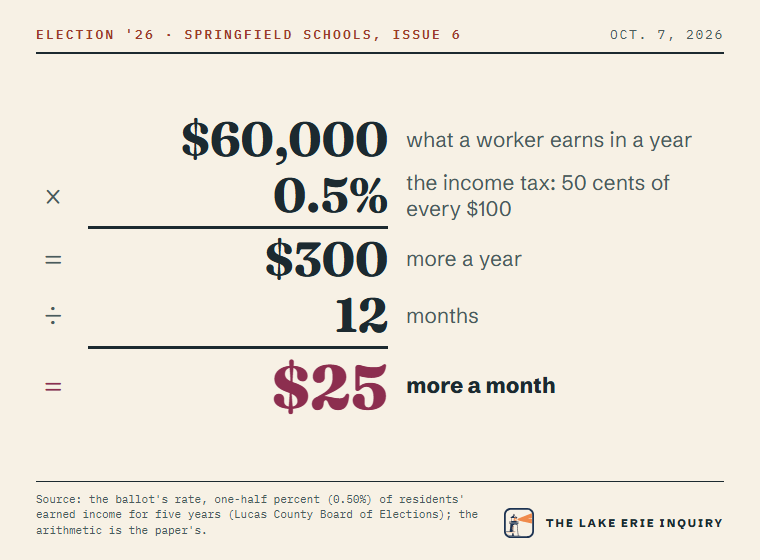
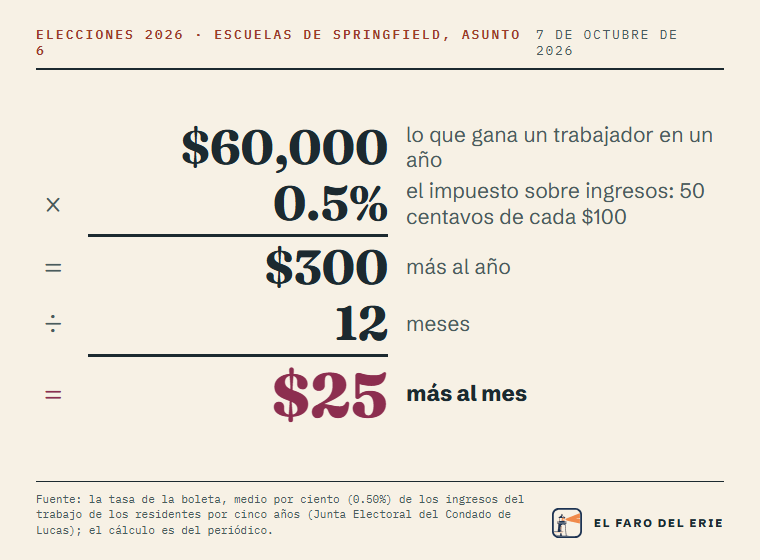
A resident who earns $60,000 would pay $300 a year, about $25 a month. Two earners making $60,000 each would pay $600.Un residente que gana $60,000 pagaría $300 al año, unos $25 al mes. Dos personas que ganan $60,000 cada una pagarían $600.
And a retiree?¿Y un jubilado?
A retiree living on a pension and Social Security pays nothing. Wages from a part-time job would be taxed.Un jubilado que vive de una pensión y del Seguro Social no paga nada. El salario de un trabajo de medio tiempo sí pagaría.
How much would it raise, and when?¿Cuánto recaudaría, y cuándo?
The ballot does not say. The district’s five-year forecast counts $2.25 million in the 2028 school year and about $4.5 million a year after that. The first money would not reach the district until July 2028, Treasurer Jackie Yackee said in a written answer: the tax would be withheld from paychecks during 2027, and the state pays it out slowly after residents file their returns.La boleta no lo dice. El pronóstico a cinco años del distrito cuenta $2.25 millones en el año escolar 2028 y unos $4.5 millones al año después. El primer dinero no llegaría al distrito hasta julio de 2028, dijo la tesorera Jackie Yackee en una respuesta por escrito: el impuesto se retendría de los cheques de pago durante 2027, y el estado lo entrega poco a poco después de que los residentes presentan sus declaraciones.
Why does the district say it needs the money?¿Por qué dice el distrito que necesita el dinero?
It spent $48.3 million from its general fund in the 2026 school year and took in $44.3 million, the forecast shows. Without new money, the district’s balance, after a $2 million reserve, falls below zero in the 2029 school year; its cash stays above zero until 2030. The forecast’s salary line counts only scheduled step raises, Yackee wrote; the employee contracts reopen in spring 2027.Gastó $48.3 millones de su fondo general en el año escolar 2026 y recibió $44.3 millones, según el pronóstico. Sin dinero nuevo, el saldo del distrito, después de una reserva de $2 millones, cae por debajo de cero en el año escolar 2029; su efectivo se mantiene sobre cero hasta 2030. La línea de salarios del pronóstico solo cuenta los aumentos escalonados programados, escribió Yackee; los contratos de los empleados se reabren en la primavera de 2027.
What if it fails?¿Y si no pasa?
The district remains in “precaution” status with the state, Yackee wrote, and received a deficit notification letter Sept. 3 telling it to reduce deficit spending by its February 2027 forecast. “If the deficit persists into February of 2027, the district will need to make more operational changes and staff reductions,” she wrote.El distrito sigue en estado de “precaución” ante el estado, escribió Yackee, y recibió el 3 de septiembre una carta de notificación de déficit que le pide reducir el gasto deficitario para su pronóstico de febrero de 2027. “Si el déficit persiste en febrero de 2027, el distrito tendrá que hacer más cambios operativos y reducciones de personal”, escribió.
Does it end?¿Tiene fin?
Yes. The tax runs five years, 2027 through 2031; after that the district would have to go back to voters.Sí. El impuesto dura cinco años, de 2027 a 2031; después el distrito tendría que volver a pedirlo a los votantes.
Sources: Lucas County Board of Elections, official sample ballot; Ohio Revised Code; Springfield Local Schools, five-year forecast (Ohio Department of Education and Workforce) and written answers; Ohio Department of Education and Workforce, report card dataFuentes: Junta Electoral del Condado de Lucas, boleta de muestra oficial; Código Revisado de Ohio; Escuelas Locales de Springfield, pronóstico a cinco años (Departamento de Educación y Fuerza Laboral de Ohio) y respuestas por escrito; Departamento de Educación y Fuerza Laboral de Ohio, datos del boletín de calificaciones
Springfield Local Schools imposes a new tax of one-half percent (0.50%) on residents' earned income for five years, starting Jan. 1, 2027, for current expenses.Las Escuelas Locales de Springfield cobran un impuesto nuevo de medio por ciento (0.50%) sobre los ingresos del trabajo de los residentes por cinco años, desde el 1 de enero de 2027, para gastos corrientes.
No income tax is imposed. The district's existing property-tax levies are not on this ballot and are not changed by this vote.No se cobra el impuesto sobre ingresos. Los impuestos a la propiedad que el distrito ya cobra no están en esta boleta y este voto no los cambia.
How it reads on your ballotCómo se lee en su boleta (en inglés)
Proposed Income Tax
Springfield Local School District
A majority affirmative vote is necessary for passage.
Shall an annual income tax of one-half per centum (0.50%) on the earned income of individuals residing in the school district be imposed by the Springfield Local School District, for a five (5) year period of time, beginning January 1, 2027, for the purpose of current expenses?
Source: Lucas County Board of Elections, official sample ballotFuente: Junta Electoral del Condado de Lucas, boleta de muestra oficial
◂ Election ’26: every race and question◂ Elecciones ’26: cada contienda y pregunta
Edited by Zach BrookeEditado por Zach Brooke