The Lake Erie Inquiry
Election ’26Elecciones ’26
4days to Nov. 3días al 3 de nov.Ballot questions, Lucas CountyPreguntas de la boleta, condado de Lucas
Sylvania Schools income taxImpuesto sobre ingresos de las escuelas de Sylvania
Sylvania Schools asks for an income tax and offers a property-tax cutLas escuelas de Sylvania piden un impuesto sobre ingresos y ofrecen un recorte al impuesto a la propiedad
Sylvania Schools is asking voters for a 1% tax on residents’ earned income, with no end date, starting Jan. 1, 2027. In the same question, the ballot cuts an existing 4.9-mill property levy to 3.2 mills, lowering its cost from $101 to $66 a year for every $100,000 of a home’s market value for as long as the income tax lasts. One vote decides both parts.Las Escuelas de Sylvania piden a los votantes un impuesto de 1% sobre los ingresos del trabajo de los residentes, sin fecha de fin, a partir del 1 de enero de 2027. En la misma pregunta, la boleta reduce un impuesto a la propiedad existente de 4.9 a 3.2 milésimas, lo que baja su costo de $101 a $66 al año por cada $100,000 del valor de mercado de una casa mientras dure el impuesto sobre ingresos. Un solo voto decide las dos partes.
The board changed course after voters turned down a property levy in May. “The community didn’t want to increase property taxes to fund our District; however, in order to continue many of our programs and opportunities, the financial need remains,” the board of education said in July, according to 13abc.La junta cambió de rumbo después de que los votantes rechazaran un impuesto a la propiedad en mayo. “La comunidad no quería aumentar los impuestos a la propiedad para financiar nuestro distrito; sin embargo, para mantener muchos de nuestros programas y oportunidades, la necesidad financiera sigue”, dijo la junta de educación en julio, según 13abc.
Who pays the income tax?¿Quién paga el impuesto sobre ingresos?
Residents of the school district, on wages and self-employment earnings. State law leaves out pensions, Social Security and investment income, and people who work in the school district but live elsewhere do not pay it.Los residentes del distrito escolar, sobre sus salarios y ganancias del trabajo por cuenta propia. La ley estatal deja fuera las pensiones, el Seguro Social y los ingresos de inversiones, y quienes trabajan en el distrito escolar pero viven en otro lugar no lo pagan.
What is the property-tax cut worth?¿Cuánto vale el recorte al impuesto a la propiedad?
The ballot cuts an existing levy from 4.9 to 3.2 mills, which it puts at $101 and $66 a year for every $100,000 of a home’s market value. Those figures are lower than the mills alone suggest because state law trims what an older levy actually collects as property values rise. For a $300,000 home, the levy falls from $303 to $198 a year, a $105 cut.La boleta reduce un impuesto existente de 4.9 a 3.2 milésimas, que fija en $101 y $66 al año por cada $100,000 del valor de mercado de una casa. Esas cifras son menores de lo que sugieren los milésimas porque la ley estatal reduce lo que un impuesto antiguo de verdad cobra a medida que sube el valor de las propiedades. Para una casa de $300,000, el impuesto baja de $303 a $198 al año, un recorte de $105.
What would a working household pay?¿Cuánto pagaría un hogar que trabaja?
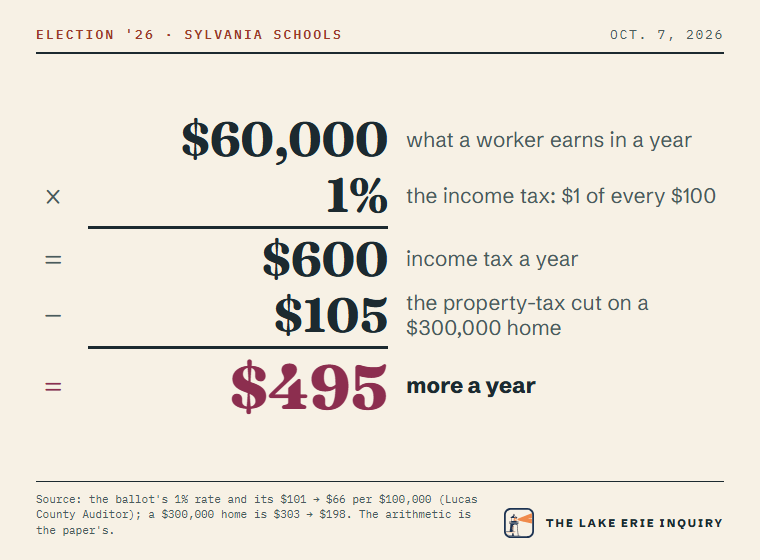
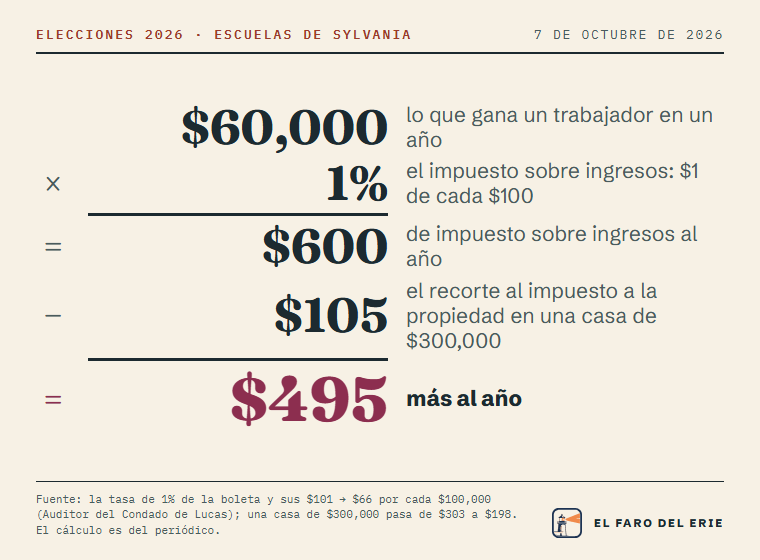
A resident who earns $60,000 and owns a $300,000 home would pay $495 more a year. On that home, the income tax and the property-tax cut even out at $10,500 of earned income ($105 ÷ 1%); a household earning more pays more than it saves.Un residente que gana $60,000 y tiene una casa de $300,000 pagaría $495 más al año. En esa casa, el impuesto sobre ingresos y el recorte se igualan con $10,500 de ingresos del trabajo ($105 ÷ 1%); un hogar que gana más paga más de lo que ahorra.
And a retiree?¿Y un jubilado?
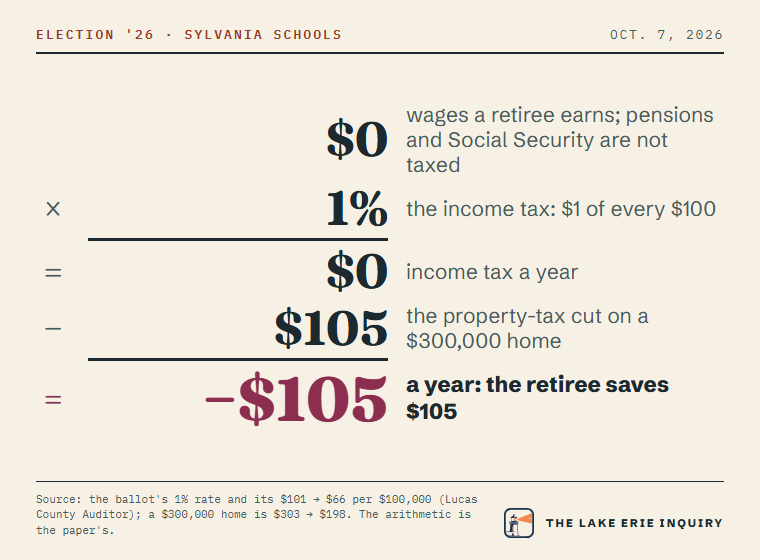
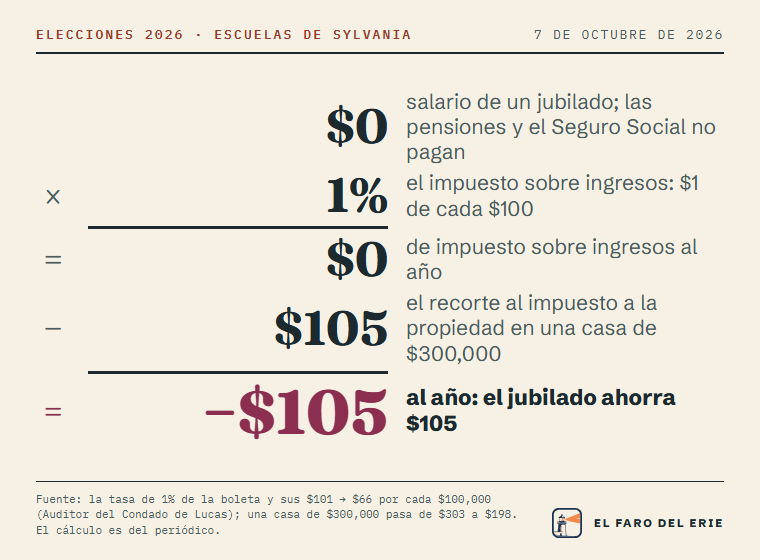
A retiree with no wages and a $300,000 home pays no income tax and saves $105 a year.Un jubilado sin salario con una casa de $300,000 no paga impuesto sobre ingresos y ahorra $105 al año.
How much would it raise?¿Cuánto recaudaría?
The ballot does not say. The Ohio Department of Taxation estimates the income tax will raise $20,586,208 a year, Treasurer Adam Koch said in a written answer, and the property-tax cut gives up $2,510,640, so the district would take in about $18.1 million more. The $4,725,909 on the ballot is what the levy will still collect at 3.2 mills, he said.La boleta no lo dice. El Departamento de Impuestos de Ohio estima que el impuesto sobre ingresos recaudará $20,586,208 al año, dijo el tesorero Adam Koch en una respuesta por escrito, y el recorte al impuesto a la propiedad cede $2,510,640, de modo que el distrito recibiría unos $18.1 millones más. Los $4,725,909 de la boleta son lo que el impuesto seguirá cobrando a 3.2 milésimas, dijo.
Why does the district say it needs the money?¿Por qué dice el distrito que necesita el dinero?
Its five-year forecast has spending growing about 3.9% a year and revenue about 0.6%, with its cash running out in the 2029 school year; without new money, it says, the district would have to cut spending about 16.3% by 2031. With the tax, Koch expects cash flow to stay positive until at least 2031 and spending to outrun revenue again starting in 2032, though “it is extremely difficult to estimate six years from now.”Su pronóstico a cinco años prevé que el gasto crezca cerca de 3.9% al año y los ingresos cerca de 0.6%, y que el efectivo se acabe en el año escolar 2029; sin dinero nuevo, dice, el distrito tendría que recortar el gasto cerca de 16.3% para 2031. Con el impuesto, Koch prevé que el flujo de caja siga positivo al menos hasta 2031 y que el gasto vuelva a superar los ingresos a partir de 2032, aunque “es extremadamente difícil estimar a seis años”.
Does it end?¿Tiene fin?
No. The income tax has no end date, and the property-tax cut lasts as long as the income tax does.No. El impuesto sobre ingresos no tiene fecha de fin, y el recorte al impuesto a la propiedad dura mientras dure el impuesto sobre ingresos.
Sources: Lucas County Auditor, levy ballot language; Ohio Revised Code; Sylvania City Schools, five-year forecast (Ohio Department of Education and Workforce) and written answers; 13abc; Ohio Department of Education and Workforce, report card dataFuentes: Auditor del Condado de Lucas, texto de la boleta; Código Revisado de Ohio; Escuelas de la Ciudad de Sylvania, pronóstico a cinco años (Departamento de Educación y Fuerza Laboral de Ohio) y respuestas por escrito; 13abc; Departamento de Educación y Fuerza Laboral de Ohio, datos del boletín de calificaciones
Sylvania Schools imposes a 1% tax on residents' earned income with no end date, starting Jan. 1, 2027, and an existing 4.9-mill property levy is cut to 3.2 mills, from $101 to $66 a year per $100,000 of market value, for as long as the income tax lasts.Las Escuelas de Sylvania cobran un impuesto de 1% sobre los ingresos del trabajo de los residentes, sin fecha de fin, desde el 1 de enero de 2027, y un impuesto a la propiedad existente de 4.9 milésimas baja a 3.2, de $101 a $66 al año por cada $100,000 de valor de mercado, mientras dure el impuesto sobre ingresos.
No income tax is imposed, and the existing 4.9-mill property levy stays at its current rate. One vote decides both parts; a voter cannot choose one without the other.No se cobra el impuesto sobre ingresos, y el impuesto a la propiedad existente de 4.9 milésimas sigue igual. Un solo voto decide las dos partes; no se puede elegir una sin la otra.
How it reads on your ballotCómo se lee en su boleta (en inglés)
Proposed Income Tax with a Property Tax Reduction
Sylvania City School District
A majority affirmative vote is necessary for passage.
Shall an annual income tax of 1% on the earned income of individuals residing in the school district be imposed by the Sylvania City School District, for a continuing period of time, beginning January 1, 2027, for the purpose of current expenses, and shall the rate of an existing tax on property, currently levied for the purpose of current expenses at the rate of 4.9 mills, be REDUCED to 3.2 mills for each $1 of taxable value, which amounts to a reduction from $101 to $66 for each $100,000 of the county auditor's market value, that the county auditor estimates will collect $4,725,909 annually, the reduction continuing until any such time as the income tax is repealed?
Source: Lucas County Board of Elections, official sample ballotFuente: Junta Electoral del Condado de Lucas, boleta de muestra oficial
◂ Election ’26: every race and question◂ Elecciones ’26: cada contienda y pregunta
Edited by Zach BrookeEditado por Zach Brooke