The Lake Erie Inquiry
Election ’26Elecciones ’26
4days to Nov. 3días al 3 de nov.Ballot questions, Lucas CountyPreguntas de la boleta, condado de Lucas
Toledo Issues 16-19: income tax and charter amendmentsToledo, asuntos 16 a 19: impuesto sobre ingresos y enmiendas a la carta
Toledo’s four ballot questions: an income tax and three charter changesLas cuatro preguntas de Toledo en la boleta: un impuesto sobre los ingresos y tres cambios a la carta
Toledo voters will find four city questions near the bottom of the ballot, numbered 16 through 19. Issue 16 is a new income tax. Issues 17, 18 and 19 change the city charter, the document that works as Toledo’s constitution; mostly, they bring it in line with state law. Each passes with a simple majority. Here is what each one does.Los votantes de Toledo encontrarán cuatro preguntas de la ciudad cerca del final de la boleta, numeradas del 16 al 19. El asunto 16 es un impuesto nuevo sobre los ingresos. Los asuntos 17, 18 y 19 cambian la carta municipal, el documento que funciona como la constitución de Toledo; en su mayoría, la ajustan a la ley estatal. Cada uno se aprueba por mayoría simple. Esto es lo que hace cada uno.
Issue 16: the income taxAsunto 16: el impuesto sobre los ingresos
What would it cost me?¿Cuánto me costaría?
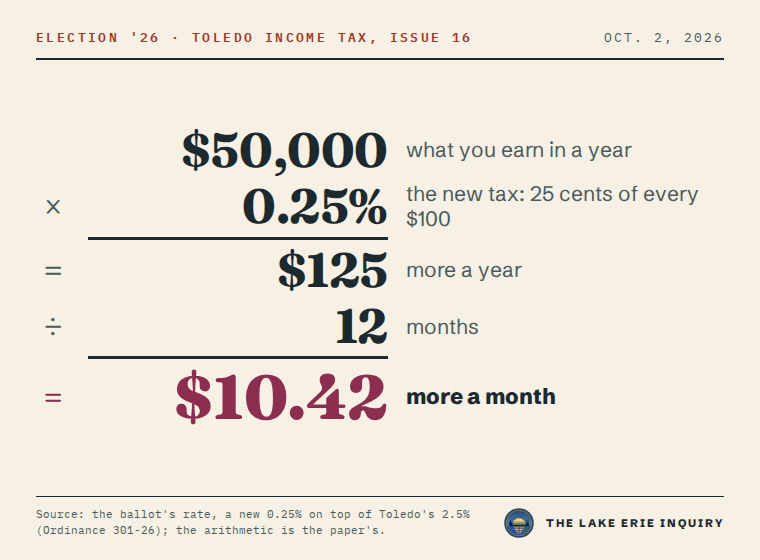
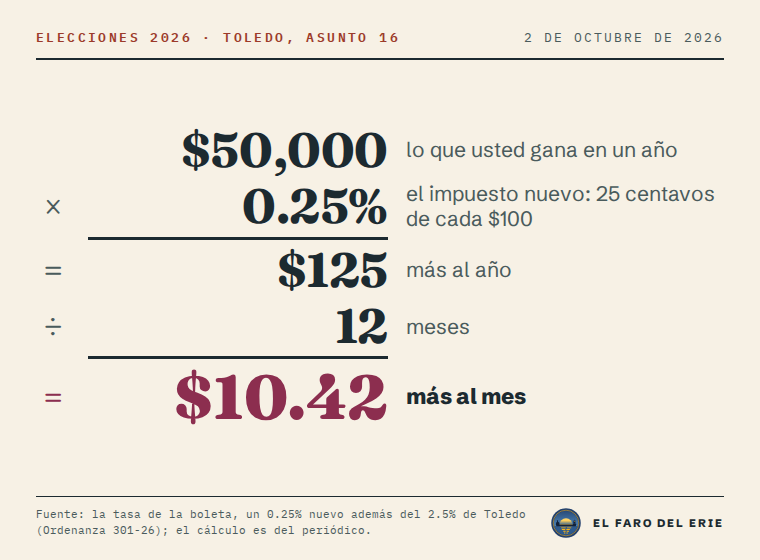
Toledo already takes 2.5% of what people earn. Issue 16 would add a quarter of a percent, 25 cents of every $100, making it 2.75%. On $50,000 a year, that is $125 more, or about $10.42 a month. On $30,000 it is $75; on $75,000, $187.50; on $100,000, $250.Toledo ya cobra el 2.5% de lo que gana la gente. El asunto 16 sumaría un cuarto por ciento, 25 centavos de cada $100, y la tasa quedaría en 2.75%. Sobre $50,000 al año son $125 más, unos $10.42 al mes. Sobre $30,000 son $75; sobre $75,000, $187.50; sobre $100,000, $250.
Who pays it?¿Quién lo paga?
People who live in Toledo, and people who work in Toledo but live somewhere else. Like the city’s other income taxes, it is a tax on wages and business profits, not on pensions or Social Security. The city has not said whether Toledo residents who work in another city, and already pay that city’s tax, would owe it.Quienes viven en Toledo y quienes trabajan en Toledo aunque vivan en otro lugar. Como los demás impuestos sobre los ingresos de la ciudad, grava los sueldos y las ganancias de las empresas, no las pensiones ni el Seguro Social. La ciudad no ha dicho si lo deberían los residentes de Toledo que trabajan en otra ciudad y ya pagan el impuesto de esa ciudad.
What would the money pay for?¿Para qué sería el dinero?
The law behind it, Ordinance 301-26, says the money can be spent only on “neighborhood safety” and on police and fire operations, “including criminal gang disruption.” The city has not published a line-by-line plan. Nothing in the ordinance stops the city from using the money for police and fire costs it already pays, which would free up other money in the budget.La ley que lo respalda, la Ordenanza 301-26, dice que el dinero solo puede usarse en “neighborhood safety” (seguridad de los vecindarios) y en las operaciones de policía y bomberos, “including criminal gang disruption” (incluida la desarticulación de pandillas). La ciudad no ha publicado un plan detallado. Nada en la ordenanza impide que la ciudad use el dinero en gastos de policía y bomberos que ya paga, lo que liberaría otro dinero del presupuesto.
Why is the city asking?¿Por qué lo pide la ciudad?
Toledo spends more than it brings in, and it has been making up the difference with money that does not come back: at a council finance committee meeting Sept. 30, a council member put the gap at $48 million to $50 million a year, and the city’s Finance Department agreed the city has one, covered by shifting money from its building-and-repair fund and spending down its savings. The city’s savings fell from $113.9 million at the end of 2024 to an expected $56 million at the end of this year, according to its statement to bond investors. Income-tax collections are also running behind: the city now expects about $11.2 million less this year than it budgeted, its August report shows. Issue 16 would raise about $25 million a year, about half the gap.Toledo gasta más de lo que recibe, y ha cubierto la diferencia con dinero que no se repite: en una reunión de la comisión de finanzas del concejo el 30 de septiembre, un miembro del concejo cifró la brecha en $48 a $50 millones al año, y el Departamento de Finanzas de la ciudad confirmó que existe y que se cubre pasando dinero del fondo de obras y reparaciones y gastando los ahorros. Los ahorros de la ciudad bajaron de $113.9 millones a fines de 2024 a unos $56 millones previstos para fines de este año, según su declaración para inversionistas en bonos. La recaudación del impuesto sobre los ingresos también va atrasada: la ciudad ahora prevé unos $11.2 millones menos de lo presupuestado este año, según su informe de agosto. El asunto 16 recaudaría unos $25 millones al año, cerca de la mitad de la brecha.
When does it end?¿Cuándo termina?
It would run from Jan. 1, 2027, through Dec. 31, 2030, then stop unless voters renew it. Two of the city’s existing income taxes, the road tax and a 0.75% tax that pays for police and fire, city operations and capital projects, expire at the end of 2028, so expect those back on the ballot before then.Duraría del 1 de enero de 2027 al 31 de diciembre de 2030, y luego terminaría salvo que los votantes lo renueven. Dos de los impuestos sobre los ingresos que la ciudad ya tiene, el de calles y uno de 0.75% que paga policía y bomberos, operaciones de la ciudad y obras de capital, vencen a fines de 2028, así que volverán a la boleta antes de esa fecha.
What if it fails?¿Y si no se aprueba?
The city would have to close the gap another way. Its 2027 budget is proposed in November, after the vote. Council already asked in March for $10 million a year in cuts for 2027 and 2028, and at a July 7 council meeting, Council President Vanice Williams said the city had come close to not holding a police and fire training class this year and would probably have layoffs in next year’s budget.La ciudad tendría que cerrar la brecha de otra manera. Su presupuesto de 2027 se propone en noviembre, después de la votación. En marzo el concejo ya pidió recortes de $10 millones al año para 2027 y 2028, y en una reunión del concejo el 7 de julio, la presidenta del concejo, Vanice Williams, dijo que este año la ciudad estuvo cerca de no tener una clase de formación de policías y bomberos y que probablemente habrá despidos en el presupuesto del año próximo.
How did council vote?¿Cómo votó el concejo?
Council sent it to the ballot July 14, 9–1. Councilwoman Cerssandra McPherson voted no.El concejo lo envió a la boleta el 14 de julio, 9 a 1. La concejala Cerssandra McPherson votó en contra.
Toledo adds a temporary 0.25% income tax, on top of its existing income taxes, from Jan. 1, 2027, through Dec. 31, 2030. The money goes to the General Fund, dedicated to neighborhood safety and to police and fire operations, including gang disruption.Toledo agrega un impuesto temporal de 0.25% sobre los ingresos, además de sus impuestos actuales sobre ingresos, del 1 de enero de 2027 al 31 de diciembre de 2030. El dinero va al Fondo General, dedicado a la seguridad de los vecindarios y a las operaciones de policía y bomberos, incluida la desarticulación de pandillas.
The added 0.25% income tax is not levied. Toledo's existing income taxes are not on this ballot and are not changed by this vote.El 0.25% adicional no se cobra. Los impuestos actuales de Toledo sobre ingresos no están en esta boleta y este voto no los cambia.
Issue 16: how it reads on your ballotAsunto 16: cómo se lee en su boleta (en inglés)
Proposed Income Tax
City of Toledo
A majority affirmative vote is necessary for passage.
Shall Ordinance (Ordinance No. 301-26) providing for a new temporary one-quarter percent (.25%) City of Toledo levy on income for the period commencing on January 1, 2027, and ending December 31, 2030, which shall be in addition to the city of Toledo's other levies on income, for the purpose of allocating the levy proceeds to the General Fund to be dedicated to neighborhood safety expenditures, and to police and fire safety force operations, including criminal gang disruption, be passed?
Source: Lucas County Board of Elections, official sample ballotFuente: Junta Electoral del Condado de Lucas, boleta de muestra oficial
Issue 17: council’s own staffAsunto 17: el personal del propio concejo
In plain English: People who work for City Council would move out of the city’s classified civil service, the part of the system that covers how most city workers are hired and protects them from being fired without cause, and into the unclassified service. Nine council employees are in it today, Clerk of Council Julie Gibbons told the paper, and if Issue 17 passes, “an unclassified employee or an exempt employee becomes an at will employee.” Council would write its own rules for hiring, discipline and firing.En palabras sencillas: Quienes trabajan para el Concejo Municipal saldrían del servicio civil clasificado de la ciudad, la parte del sistema que rige cómo se contrata a la mayoría de los trabajadores de la ciudad y los protege de ser despedidos sin causa, y pasarían al servicio no clasificado. Hoy hay nueve empleados del concejo en ese sistema, dijo a este periódico la secretaria del concejo, Julie Gibbons, y si se aprueba el asunto 17, “an unclassified employee or an exempt employee becomes an at will employee” (un empleado no clasificado o exento pasa a ser un empleado a voluntad, que puede ser despedido sin causa). El concejo escribiría sus propias reglas de contratación, disciplina y despido.
Why?¿Por qué?
Council’s July 7 minutes record the aim as making council’s office work like the mayor’s, whose assistants are already in the unclassified service. Council passed it 10–0 (Ordinance 302-26).Las actas del concejo del 7 de julio registran que el objetivo es que la oficina del concejo funcione como la del alcalde, cuyos asistentes ya están en el servicio no clasificado. El concejo lo aprobó 10 a 0 (Ordenanza 302-26).
Toledo Council gains the power to set the conditions of employment, including hiring, discipline and firing, for its own officers and employees, who become members of the unclassified service. The charter's definition of employee is updated to match.El Concejo de Toledo obtiene el poder de fijar las condiciones de empleo, incluidas la contratación, la disciplina y el despido, de sus propios funcionarios y empleados, que pasan al servicio no clasificado. La definición de empleado en la carta se actualiza para coincidir.
Chapter I, Section 6; Chapter IV, Section 33; and Chapter VIII, Section 171 of the Toledo charter stay as they are now.El capítulo I, sección 6; el capítulo IV, sección 33, y el capítulo VIII, sección 171 de la carta de Toledo quedan como están.
Issue 17: how it reads on your ballotAsunto 17: cómo se lee en su boleta (en inglés)
Proposed Charter Amendment
City of Toledo
A majority affirmative vote is necessary for passage.
Chapter I, Section 6 to be amended to remove outdated language and updating definition of employee to include members of the unclassified service.
Chapter IV, Section 33 to be amended to allow City Council to determine the conditions of employment for its officers and employees, including matters such as hiring, discipline, and termination.
Chapter VIII, Section 171 to be amended to designate that City Council officers and employees are members of the unclassified service.
Shall the proposed amendments to the Charter of the City of Toledo, as set forth in Ordinance 302-26, be adopted?
Source: Lucas County Board of Elections, official sample ballotFuente: Junta Electoral del Condado de Lucas, boleta de muestra oficial
Issue 18: election and petition rulesAsunto 18: reglas de elecciones y peticiones
In plain English: It rewrites the charter’s election rules to match Ohio law. The main changes: People running for city office no longer file a separate written acceptance of their nomination. Their nominating petitions are due 90 days before the primary instead of 60. A write-in vote counts only for a candidate who filed the state’s form declaring a write-in run. And citizen petitions, which let voters put a law on the ballot or challenge one council passed, must use the state’s forms and go to the next election at least 90 days out, instead of 75.En palabras sencillas: Reescribe las reglas electorales de la carta para ajustarlas a la ley de Ohio. Los cambios principales: Quienes se postulan a cargos de la ciudad ya no presentan una aceptación escrita aparte de su nominación. Sus peticiones de candidatura se entregan 90 días antes de la primaria en vez de 60. Un voto por escrito solo cuenta para un candidato que presentó el formulario estatal que declara su candidatura por escrito. Y las peticiones ciudadanas, que permiten a los votantes poner una ley en la boleta o impugnar una que aprobó el concejo, deben usar los formularios del estado e ir a la siguiente elección que ocurra al menos 90 días después, en vez de 75.
What the ballot doesn’t tell you: The 60-to-90-day petition deadline is in the full text but not the ballot summary. And where the summary speaks of a deadline “within” which a petition election must be held, the text sets a minimum: a petition waits for an election at least 90 days away. Council did not answer the paper’s questions about the wording.Lo que la boleta no dice: El plazo de 60 a 90 días para las peticiones está en el texto completo, pero no en el resumen de la boleta. Y donde el resumen habla de un plazo “within” (dentro del cual) debe celebrarse una elección por petición, el texto fija un mínimo: una petición espera una elección que esté al menos a 90 días. El concejo no respondió las preguntas de este periódico sobre la redacción.
Why?¿Por qué?
Council says the charter and state election law disagree, and this streamlines the process. It passed 8–2 (Ordinance 304-26).El concejo dice que la carta y la ley electoral del estado no coinciden, y que esto simplifica el proceso. Se aprobó 8 a 2 (Ordenanza 304-26).
Toledo's charter drops the separate written acceptance of nomination for primary candidates and moves their petition deadline from 60 to 90 days before the primary, requires write-in candidates and petitioners to use the state's forms, and holds an election on a referendum or initiative petition no sooner than 90 days, instead of 75, after the clerk certifies it.La carta de Toledo elimina la aceptación escrita aparte de la nominación para los candidatos a la primaria y adelanta su plazo de peticiones de 60 a 90 días antes de la primaria, exige que los candidatos por escrito (write-in) y los peticionarios usen los formularios del estado, y celebra la elección sobre una petición de referéndum o iniciativa no antes de 90 días, en vez de 75, después de que la secretaria la certifique.
Chapter III, Sections 14 and 17, and Chapter VI, Sections 83 and 92 of the Toledo charter stay as they are now.El capítulo III, secciones 14 y 17, y el capítulo VI, secciones 83 y 92 de la carta de Toledo quedan como están.
Issue 18: how it reads on your ballotAsunto 18: cómo se lee en su boleta (en inglés)
Proposed Charter Amendment
City of Toledo
A majority affirmative vote is necessary for passage.
Chapter III, Section 14 to be amended to update language to be more aligned with state law, and in particular to remove the requirement that a candidate who has filed a nominating petition for a primary election must also file a written acceptance of nomination with election authorities.
Chapter III, Section 17 to be amended to bring the criteria for designation as a write-in candidate in line with state election law by requiring any potential write-in candidate to declare their intent to run on the forms prescribed by the state.
Chapter VI, Section 83 to be amended to increase the deadline for which an election on referendum or initiative petitions must be held within from 75 days to 90 days.
Chapter VI, Section 92 to be amended to require any petitions filed to be consistent with the forms prescribed by the state.
Shall the proposed amendments to the Charter of the City of Toledo, as set forth in Ordinance 304-26, be adopted?
Source: Lucas County Board of Elections, official sample ballotFuente: Junta Electoral del Condado de Lucas, boleta de muestra oficial
Issue 19: how the charter gets changedAsunto 19: cómo se cambia la carta
In plain English: Housekeeping. The Ohio Constitution says a city council sends charter changes to voters by ordinance; Toledo’s charter says by resolution. This makes the charter match, and council already uses ordinances in practice, including for Issues 17 and 18. It also rewrites the section as a clearer step-by-step list. What it takes to put a charter change on the ballot does not change: two-thirds of council, or a petition signed by 10% of voters. Council passed it 10–0 (Ordinance 305-26).En palabras sencillas: Es un ajuste de forma. La Constitución de Ohio dice que un concejo municipal envía los cambios a la carta a los votantes por ordenanza; la carta de Toledo dice por resolución. Esto hace que la carta coincida, y en la práctica el concejo ya usa ordenanzas, incluso para los asuntos 17 y 18. También reescribe la sección como una lista de pasos más clara. Lo que se necesita para poner un cambio a la carta en la boleta no cambia: dos tercios del concejo, o una petición firmada por el 10% de los votantes. El concejo lo aprobó 10 a 0 (Ordenanza 305-26).
Toledo's charter requires Council to approve proposed charter amendments by ordinance instead of by resolution, and rewrites Chapter I, Section 5 to describe the amendment process more clearly.La carta de Toledo exige que el concejo apruebe las enmiendas propuestas a la carta por ordenanza en vez de por resolución, y reescribe el capítulo I, sección 5 para describir con más claridad el proceso de enmienda.
Chapter I, Section 5 of the Toledo charter stays as it is now, including approval of proposed charter amendments by resolution.El capítulo I, sección 5 de la carta de Toledo queda como está, incluida la aprobación de enmiendas propuestas por resolución.
Issue 19: how it reads on your ballotAsunto 19: cómo se lee en su boleta (en inglés)
Proposed Charter Amendment
City of Toledo
A majority affirmative vote is necessary for passage.
Shall Chapter I, Section 5 be amended to be consistent with the Ohio Constitution by requiring Council to approve proposed Charter amendments by an ordinance rather than a resolution, and to rewrite the Section to describe the requirements of the Charter amendment process more clearly, as set forth in Ordinance 305-26?
Source: Lucas County Board of Elections, official sample ballotFuente: Junta Electoral del Condado de Lucas, boleta de muestra oficial
Want the full text?¿Quiere el texto completo?
The ordinance behind each issue is linked in its entry above. The full text of the three charter amendments will also run as a legal notice in The Blade on Sunday, Oct. 4, and Sunday, Oct. 11, Gibbons said.La ordenanza de cada asunto tiene su enlace en su entrada, arriba. El texto completo de las tres enmiendas a la carta también se publicará como aviso legal en The Blade el domingo 4 y el domingo 11 de octubre, dijo Gibbons.
Questions sent: on Sept. 28 the paper sent questions to Mayor Wade Kapszukiewicz, Council President Vanice Williams, Clerk of Council Julie Gibbons, and Councilmembers Cerssandra McPherson, Adam Martinez and Sam Melden. Williams referred the questions to Gibbons, who answered some of them for council in writing Sept. 30; Martinez’s office replied. The mayor, McPherson and Melden did not respond.Preguntas enviadas: el 28 de septiembre este periódico envió preguntas al alcalde Wade Kapszukiewicz, a la presidenta del concejo Vanice Williams, a la secretaria del concejo Julie Gibbons y a los concejales Cerssandra McPherson, Adam Martinez y Sam Melden. Williams remitió las preguntas a Gibbons, quien respondió algunas por el concejo por escrito el 30 de septiembre; la oficina de Martinez contestó. El alcalde, McPherson y Melden no respondieron.
Sources: Lucas County Board of Elections, sample ballot; Toledo City Council, Ordinances 301-26, 302-26, 304-26 and 305-26, the July 7 minutes and recording, and the July 14 roll calls; City of Toledo, 2026 Annual Information Statement and the Finance Director’s August report; Toledo City Council’s Finance, Debt & Budget Oversight Committee, Sept. 30, 2026, from the city’s recording; written answers from Clerk of Council Julie Gibbons, Sept. 30, 2026.Fuentes: Junta Electoral del Condado de Lucas, boleta de muestra; Concejo Municipal de Toledo, ordenanzas 301-26, 302-26, 304-26 y 305-26, el acta y la grabación del 7 de julio, y las votaciones del 14 de julio; Ciudad de Toledo, Declaración Informativa Anual de 2026 e informe de agosto de la directora de Finanzas; Comisión de Finanzas, Deuda y Supervisión Presupuestaria del Concejo Municipal de Toledo, 30 de septiembre de 2026, según la grabación de la ciudad; respuestas escritas de la secretaria del concejo, Julie Gibbons, 30 de septiembre de 2026.
La boleta del condado de Lucas se imprime solo en inglés. Si necesita ayuda para leerla, puede llevar a la cabina a la persona que usted elija, salvo a su empleador o a un representante de su sindicato. La persona no tiene que estar inscrita para votar.
Fuente: guía de MALDEF para votantes de Ohio
◂ Election ’26: every race and question◂ Elecciones ’26: cada contienda y pregunta
Edited by Zach BrookeEditado por Zach Brooke