






The Lake Erie Inquiry
Friday, Oct. 30, 2026viernes 30 de octubre de 2026 · No. 93n.º 93
Arts & CultureArte y Cultura
the Friday beatel tema de los viernes
- Ten kings reunite before one leaves the showDiez reyes se reúnen antes de que uno salga de la muestra
- A final evening for Toledo’s women tattoo artistsÚltima noche para las tatuadoras de Toledo
- Morrison’s clearing becomes art, with one evening leftLa literatura de Morrison se vuelve arte en Cleveland
- A stock ticker measures Black well-being at UMMAUn panel bursátil muestra el bienestar negro en UMMA
- Detroit artists enter every contemporary gallery at DIAArtistas de Detroit estarán en cada sala contemporánea del DIA
- Libbey Glass Company’s 1904 World’s Fair punch bowl and, in front, the ladle made for it,…Libbey Glass Company’s 1904 World’s Fair punch bowl and, in front, the ladle made for it,…
Ten kings reunite before one leaves the showDiez reyes se reúnen antes de que uno salga de la muestra
Ten medieval Korean paintings of the judges of the dead are together in Cleveland for the first time since the 1960s. Visit before Dec. 1 to see the original group intact: one king leaves at the exhibition’s rotation even though the show continues into January.Diez pinturas coreanas medievales de los jueces de los muertos se reúnen en Cleveland por primera vez desde la década de 1960. Hay que ir antes del 1 de diciembre para ver el conjunto original completo: uno de los reyes se retira en la rotación de obras, aunque la exposición continúa hasta enero.
Ten Kings of Hell: The Afterlife in Medieval Korea, at the Cleveland Museum of Art, reunites hanging scrolls from the 1300s now held by six museums. The exhibition opened Oct. 11. The missing piece was the Third King, whose whereabouts had eluded scholars for more than 50 years.Ten Kings of Hell: The Afterlife in Medieval Korea, en el Cleveland Museum of Art, reúne rollos colgantes del siglo XIV que hoy pertenecen a seis museos. La exposición abrió el 11 de octubre. La pieza que faltaba era el Tercer Rey, cuyo paradero los especialistas desconocían desde hacía más de 50 años.
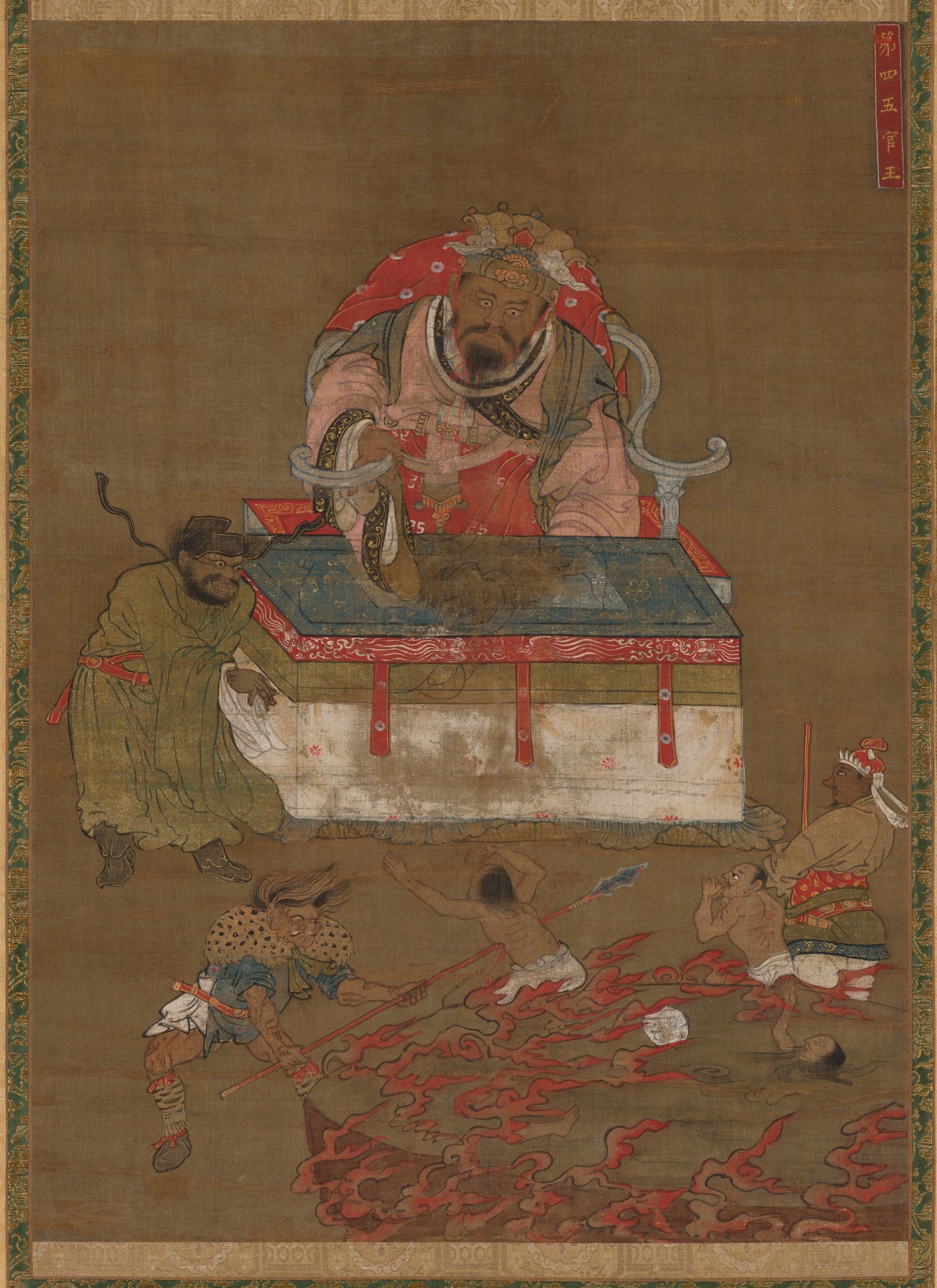
In this Buddhist tradition, the afterlife has a court system. Kings examine the deeds of the dead and determine punishments and the course of rebirth. The first seven judgments come at seven-day intervals after death; the remaining hearings fall on the hundredth day and the first and third anniversaries.En esta tradición budista, el más allá tiene su propio sistema judicial. Los reyes examinan las acciones de los difuntos y determinan los castigos y el curso del renacimiento. Los primeros siete juicios se celebran a intervalos de siete días después de la muerte; los restantes, al cumplirse cien días y en el primer y tercer aniversario.
The paintings make that reckoning visible. In Cleveland’s Fourth King, a crowned ruler sits behind a desk while guards torment people around a fiery cauldron below. Families made offerings during funerary rites in hopes of sparing the deceased severe judgments, the museum says.Las pinturas hacen visible ese ajuste de cuentas. En el Cuarto Rey de Cleveland, un soberano coronado se sienta tras una mesa mientras, abajo, los guardias atormentan a personas alrededor de un caldero en llamas. Las familias hacían ofrendas en los ritos funerarios con la esperanza de evitar sentencias severas a los difuntos, según el museo.
The reunited set has its own history of separation. Dealer and collector Harry G. C. Packard once held the paintings; gifts, purchases and an auction carried them into different collections. During preparations for this exhibition, the Third King was identified in the Museum of Modern Art, Gunma, Japan. It had been there since 1974, curator Sooa Im McCormick writes.El conjunto tiene su propia historia de separación. Las pinturas estuvieron en manos del marchante y coleccionista Harry G. C. Packard; donaciones, compras y una subasta las repartieron entre distintas colecciones. Durante los preparativos de esta exposición, el Tercer Rey fue identificado en el Museum of Modern Art de Gunma, Japón. Estaba allí desde 1974, según escribe la curadora Sooa Im McCormick.
McCormick has placed the kings around Kṣitigarbha, a Buddhist savior figure.McCormick ha dispuesto los reyes alrededor de Kṣitigarbha, una figura salvadora del budismo.
The reunion is temporary. The exhibition closes for one day, Dec. 1, for a rotation of works; afterward the original Third King is replaced by Gala Porras-Kim’s contemporary The Third King of Hell Afterimage. The show, organized with the National Museum of Korea, runs through Jan. 3, 2027.La reunión es temporal. La exposición cierra solo el 1 de diciembre por una rotación de obras; después, el Tercer Rey original será sustituido por la obra contemporánea de Gala Porras-Kim The Third King of Hell Afterimage. La muestra, organizada con el National Museum of Korea, continúa hasta el 3 de enero de 2027.
Admission to the special exhibition requires a ticket. The museum’s exhibition page has reservations and visitor information.La exposición especial requiere entrada. La página del museo ofrece reservas e información para la visita.
Sources: Cleveland Museum of Art announcement; McCormick’s account; Smithsonian glossary; Fourth King catalog; CMA on funerary offerings.Fuentes: comunicado del Cleveland Museum of Art; relato de McCormick; glosario del Smithsonian; catálogo del Cuarto Rey; CMA sobre ofrendas funerarias.
A final evening for Toledo’s women tattoo artistsÚltima noche para las tatuadoras de Toledo
Women tattoo artists from the Toledo area show their work alongside recreations of designs by influential women in tattoo history at the Portal at Toledo School for the Arts. Painted Ladies: Women in Tattooing closes tonight with a free reception from 6 to 8 p.m., at 1401 Adams St.Tatuadoras de la zona de Toledo presentan sus obras junto a recreaciones de diseños de mujeres influyentes en la historia del tatuaje en el Portal de Toledo School for the Arts. Painted Ladies: Women in Tattooing cierra esta noche con una recepción gratuita de 6 a 8 p.m., en 1401 Adams St.
Sources: The Portal.Fuentes: The Portal.
Morrison’s clearing becomes art, with one evening leftLa literatura de Morrison se vuelve arte en Cleveland
Five Ohio artists turn Toni Morrison’s ideas into photography, prints, sound and installation at Zygote Press, where A Clearing: Word, Image, Body closes today. The gallery describes photographs of parcels of land, prints laid out like real-estate plots and sound pieces built as landscapes. Three participating artists, Tatyana Atkinson, Euzhan Shabazz and solo, join curators Scout Bach and Tony Huffman for a conversation tonight, 5:30–7:30 p.m., at 3907 Perkins Ave. in Cleveland. Regular Friday gallery hours are noon–5 p.m.; the conversation is a separate evening program. The organizer’s event page gives no admission charge.Cinco artistas de Ohio transforman las ideas de Toni Morrison en fotografía, grabados, sonido e instalación en Zygote Press, donde A Clearing: Word, Image, Body cierra hoy. La galería describe fotografías de parcelas de tierra, grabados trazados como lotes inmobiliarios y piezas sonoras construidas como paisajes. Tres participantes, Tatyana Atkinson, Euzhan Shabazz y solo, conversan con los curadores Scout Bach y Tony Huffman esta noche, de 5:30 a 7:30 p.m., en 3907 Perkins Ave., Cleveland. El horario habitual de los viernes es de mediodía a 5 p.m.; la conversación es un programa nocturno aparte. La página del evento no indica precio de entrada.
Sources: Exhibition; Artist talk.Fuentes: Exposición; Charla.
A stock ticker measures Black well-being at UMMAUn panel bursátil muestra el bienestar negro en UMMA
Rick Lowe turns a stock ticker into art about Black wealth and opportunity at Ann Arbor’s University of Michigan Museum of Art. The 40-foot rooftop LED ticker displays data on Black well-being from two University of Michigan research efforts, the Panel Study of Income Dynamics and the Anti-Black Index. More than 20 new works inside, the culmination of Lowe’s three-year residency at the Institute for Social Research, turn eight years of his research into visual form. Black Wall Street Journey is free and runs through Jan. 24. The outdoor ticker keeps reduced hours through Sunday while the museum serves as a voting hub.Rick Lowe convierte el panel bursátil en arte sobre riqueza y oportunidades de la población negra en el University of Michigan Museum of Art de Ann Arbor. El panel LED de 40 pies en la azotea muestra datos sobre el bienestar de la población negra de dos investigaciones de la Universidad de Michigan, el Panel Study of Income Dynamics y el Anti-Black Index. Dentro, más de 20 obras nuevas, culminación de la residencia de tres años de Lowe en el Institute for Social Research, convierten ocho años de su investigación en forma visual. Black Wall Street Journey es gratuita y sigue hasta el 24 de enero. El panel exterior funciona con horario reducido hasta el domingo mientras el museo sirve como centro de votación.
Update, Oct. 30: This item has been updated with more information about the research behind the exhibition.Actualización, 30 de octubre: Esta nota se actualizó con más información sobre la investigación detrás de la exposición.
Sources: UMMA exhibition and ticker schedule.Fuentes: Exposición y horario del panel.
Detroit artists enter every contemporary gallery at DIAArtistas de Detroit estarán en cada sala contemporánea del DIA
Detroit artists will appear in every contemporary gallery when the Detroit Institute of Arts reopens its modern and contemporary collections Nov. 15. The first comprehensive contemporary reinstallation since 2007 brings more than 120 works into ten themed galleries. Director Salvador Salort-Pons says nearly 40% of the contemporary works will be on view at the DIA for the first time. Visitors will encounter Thomas J. Price’s monumental bronze A Place Beyond, depicting a young Black woman holding a phone; Detroit works include Tiff Massey’s Baby Bling and Carole Harris’s This Side of the River.Habrá artistas de Detroit en cada sala contemporánea cuando el Detroit Institute of Arts reabra sus colecciones moderna y contemporánea el 15 de noviembre. La primera reorganización integral de las salas contemporáneas desde 2007 reúne más de 120 obras en diez salas temáticas. El director Salvador Salort-Pons dice que casi el 40% de las obras contemporáneas se exhibirá por primera vez en el DIA. Los visitantes encontrarán A Place Beyond, el bronce monumental de Thomas J. Price de una joven negra con un teléfono; las obras de Detroit incluyen Baby Bling, de Tiff Massey, y This Side of the River, de Carole Harris.
Sources: Contemporary reinstallation; Director’s account.Fuentes: Reorganización contemporánea; Relato del director.
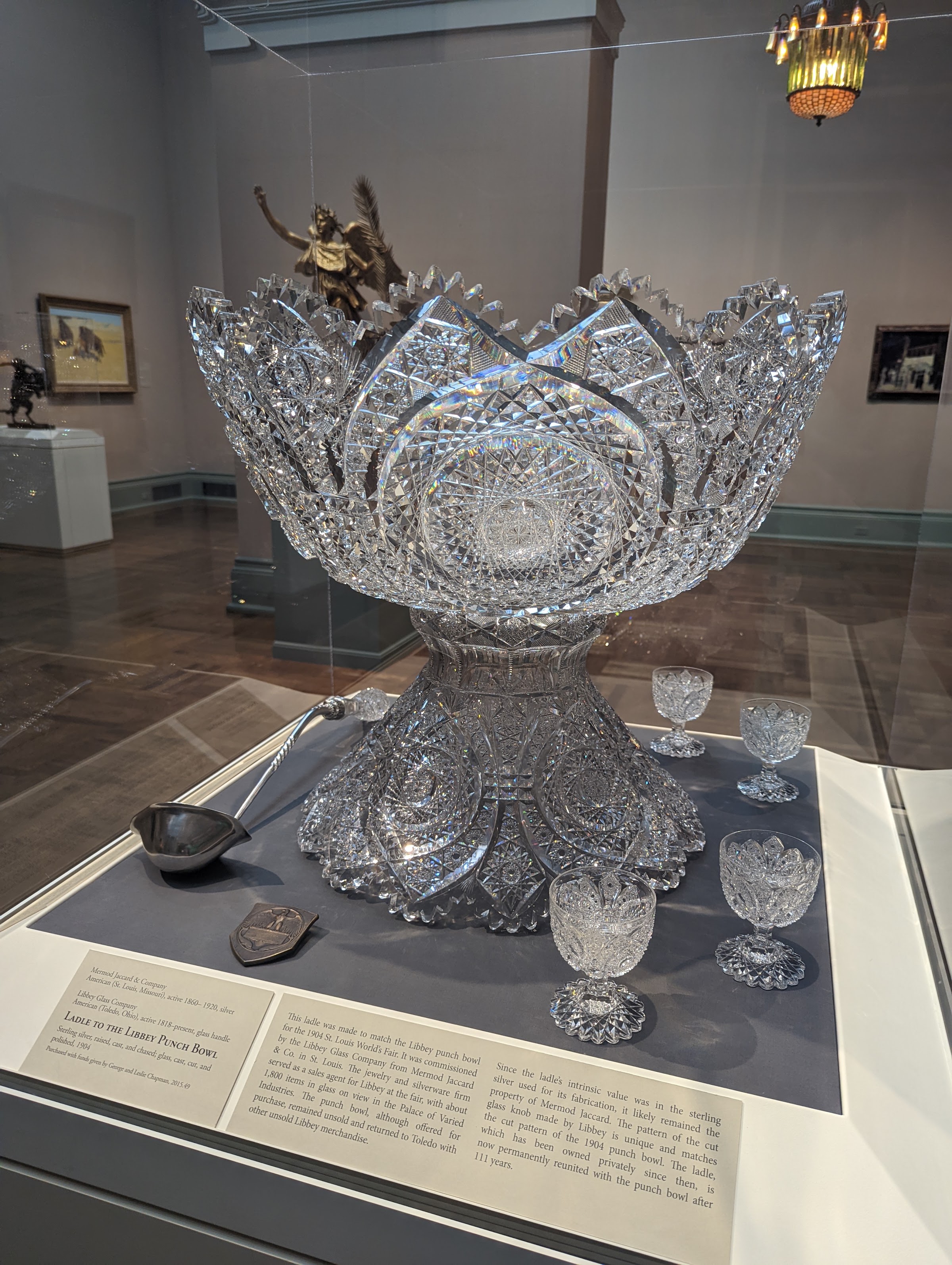
Mermod Jaccard & Company of St. Louis, with Libbey Glass Company of Toledo: Punch Bowl Ladle, 1904, sterling silver with a cut-glass handle knob. It was made to go with the punch bowl behind it, which Libbey built for the 1904 St. Louis World’s Fair and which, the museum’s catalog entry for the bowl says, was proclaimed the largest single piece of cut glass in the world at the time.Mermod Jaccard & Company de San Luis, con Libbey Glass Company de Toledo: Cucharón para ponchera, 1904, plata esterlina con una perilla de cristal tallado en el mango. Se hizo para acompañar a la ponchera que está detrás, que Libbey fabricó para la Feria Mundial de San Luis de 1904 y que, según el registro de catálogo del museo para la ponchera, fue proclamada la pieza individual de cristal tallado más grande del mundo en ese momento.
The thing to notice is the knob. Everything else on the ladle is silver, but the little glass knob is cut in the same pattern as the bowl, a detail that ties the silver to the glass. The bowl itself, about two feet across, got its fine cutting from two Libbey craftsmen, J. Rufus Denman and Patrick Walker.Lo que hay que notar es la perilla. Todo lo demás en el cucharón es de plata, pero la pequeña perilla de cristal está tallada con el mismo diseño que la ponchera, un detalle que une la plata con el cristal. La ponchera, de unos dos pies de ancho, recibió su tallado fino de dos artesanos de Libbey, J. Rufus Denman y Patrick Walker.
The two split up after the fair. The bowl did not sell and came home to Toledo with the rest of Libbey’s unsold glass; Libbey gave it to the museum in 1946. The silver ladle most likely stayed with Mermod Jaccard, Libbey’s sales agent at the fair, and was in private hands until the museum bought it in 2015 with money from George and Leslie Chapman, putting the set back together after 111 years. The museum’s catalog now lists both pieces as not on view. The publisher photographed them in the galleries on July 10, 2022.Los dos se separaron después de la feria. La ponchera no se vendió y volvió a Toledo con el resto del cristal que Libbey no vendió; Libbey la donó al museo en 1946. El cucharón de plata probablemente se quedó con Mermod Jaccard, el agente de ventas de Libbey en la feria, y estuvo en manos privadas hasta que el museo lo compró en 2015 con dinero de George y Leslie Chapman, reuniendo el juego después de 111 años. El catálogo del museo muestra ahora ambas piezas como no expuestas. El editor las fotografió en las salas el 10 de julio de 2022.
Sources: the museum’s wall label for the ladle, read in the photograph; the Toledo Museum of Art’s catalog records for the ladle and the punch bowl, which carry the makers, dates, materials, size, credit lines, object numbers and current status, and the bowl’s label text.Fuentes: la ficha del museo para el cucharón, leída en la fotografía; los registros de catálogo del Museo de Arte de Toledo para el cucharón y la ponchera, con los fabricantes, las fechas, los materiales, las medidas, las líneas de crédito, los números de objeto y su estado actual, y el texto de la ficha de la ponchera.
Edited by Zach BrookeEditado por Zach Brooke